What Is Leadership Coaching and How Does It Help Indian Organizations?


Most HR leaders in India do not need convincing that their managers are under pressure. What they need, usually just before a budget conversation, is a clear answer to a simple question from a CFO or a business head: what exactly is leadership coaching, and what will it do that a training program will not?
It is a fair question, and the coaching industry has not always answered it well. The word gets attached to everything from a two-hour workshop to a chatbot. This guide sets out what leadership coaching actually is, how an engagement runs, and where it helps organizations in India specifically.
What leadership coaching is
Leadership coaching is a structured, confidential working relationship between a trained coach and a leader, usually one to one, held over a set period and focused on how that leader operates at work.
The coach does not supply answers. They ask questions that help the leader examine a situation more clearly, surface the assumptions they are making, consider options they have not considered, commit to an approach, try it in the real workplace, and then review what happened. The material is whatever the leader brings: a team that is not performing, a peer relationship that has turned difficult, a decision they keep postponing, a promotion they do not yet feel ready for.
A typical engagement runs six to twelve sessions over six to twelve months, often an hour each, delivered in person or virtually. Shorter engagements of four to six sessions can work for a specific transition. Sessions are confidential. Where an organization sponsors the coaching, it normally receives confirmation of attendance and progress against agreed goals, not the content of what was discussed.
What leadership coaching is not
This is where most confusion sits, and it is worth being exact.
- It is not training. Training transfers knowledge to a group against a curriculum. Coaching works on one person's behavior in their specific situation, and there is no syllabus.
- It is not consulting. A consultant analyzes your problem and recommends a solution. A coach helps the leader arrive at their own, which is what makes it stick when the coach is gone.
- It is not mentoring. A mentor is a more experienced person in your field sharing what worked for them. A coach does not need to have done the leader's job and does not give advice from their own career.
- It is not therapy. Coaching works with present-day workplace challenges and forward action, not clinical or psychological treatment. A credible coach refers out when something falls outside that boundary.
- It is not performance management. Coaching is not a disciplinary step, and framing it that way in an organization is the fastest way to make leaders avoid it.
Why this matters for Indian organizations right now
Three things make the manager layer in India an unusually high-leverage place to invest, and one of them is newly documented.
Manager engagement in India has dropped sharply
Gallup's State of the Global Workplace 2026 report found that 23% of employees in India are engaged at work, the lowest figure in four years, with 59% not engaged. That is still above the global average of 20%, so the headline is not that India is behind.
The finding that should interest HR teams is about managers. Gallup reports that manager engagement in India has fallen by nine percentage points since 2024, dropping from 39% to 30%. Managers remain more engaged than individual contributors, who sit at 19%, but a nine-point fall in a single year is a signal about the layer the entire organization depends on to translate strategy into daily work.
A disengaged manager does not usually quit. They narrow. They do the operational minimum, avoid the difficult conversation, stop developing their people, and keep delivering just enough. That pattern is close to invisible on a dashboard and expensive everywhere else.
Promotion into management often outpaces preparation
In India's technology, services and startup sectors, strong individual performers move into people leadership quickly. The skills that earned the promotion, technical depth and personal delivery, are not the skills the new role needs. Nobody teaches most new managers how to give feedback that changes behavior, how to delegate work they could do faster themselves, or how to hold a standard without becoming the bottleneck.
A training program can introduce those ideas. Applying them with a specific team, under real pressure, is where coaching for managers does work that a classroom cannot.
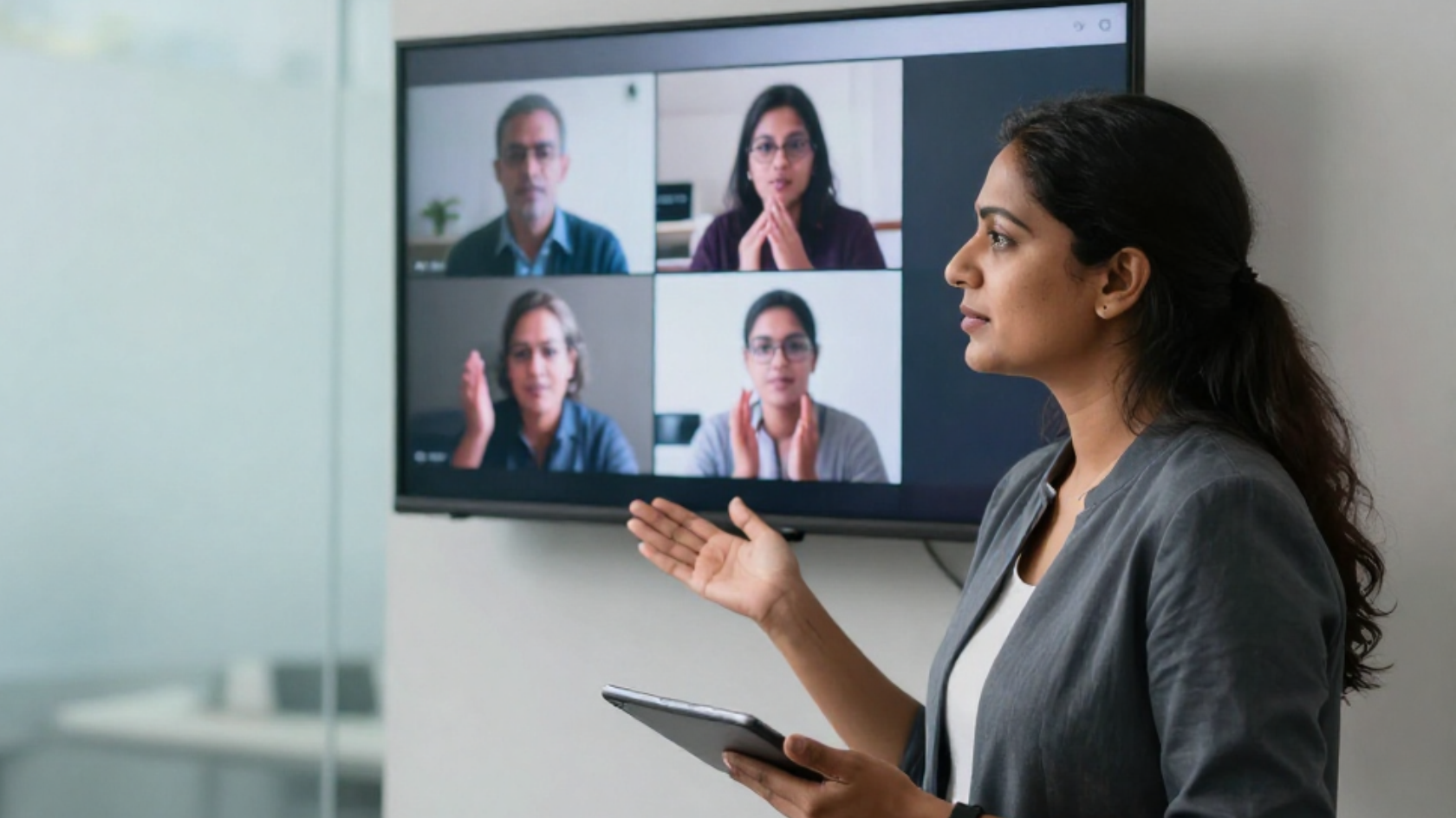
India-based leaders increasingly hold global mandates
The Nasscom-Zinnov GCC Landscape Report 2026 counts 2,117 global capability centers in India, employing 2.36 million people, with centers increasingly holding global ownership rather than delivery alone.
That shift changes what leadership requires. A leader running a global function from Bengaluru or Hyderabad is influencing stakeholders across time zones, managing without direct authority, and representing their organization in rooms where the norms are different. Those are exactly the areas where leadership coaching in India gets bought: not to fix a weak leader, but to extend a capable one into a bigger role.
How a coaching engagement actually runs
For HR teams who have not commissioned coaching before, the mechanics matter as much as the concept.
- Matching. The leader is matched with a coach on the basis of context, experience and language, and usually meets one or two before choosing. Fit is not something you can judge from a profile, so a no-fault rematch option is reasonable to insist on.
- Goal setting. The leader sets goals, often in a three-way conversation with their manager so the organization's expectations are on the table from the start.
- The sessions. Regular, confidential, structured. The leader brings live situations. Work happens between sessions, in the actual workplace, which is the part that produces change.
- Review. Progress is reviewed against the goals agreed at the start, with the leader's manager where appropriate.
- Credentials. Ask what standard the provider holds coaches to. Working with an ICF-certified coach means a defined competency framework, supervision and published ethics standards sit behind the engagement, which matters when conversations involve confidential concerns about colleagues or the business.
Where an organization wants coaching across multiple cities or many managers rather than a handful of executives, a digital coaching platform handles the matching, scheduling and reporting that otherwise defeats the program.
What to expect, and what not to claim
Coaching does not guarantee a business result, and any provider promising a fixed return on investment should be treated with caution.
What organizations can reasonably look for over an engagement: a leader who can describe what they are doing differently and why, decisions that were stuck getting made, difficult conversations happening earlier rather than after damage is done, more consistent delegation, and feedback from the team that something has changed. Those are observable, and they are the honest basis for deciding whether to extend a program.
If you are building the internal case, our guide on corporate coaching in India covers how coaching fits into bench strength planning rather than sitting as a standalone benefit.

Who should get coaching first
Most organizations cannot fund coaching for everyone, and should not try. The usual priorities:
- Leaders in transition, including newly promoted managers and anyone taking on significantly larger scope
- Identified successors for critical roles
- Senior leaders whose decisions carry disproportionate consequence, and who have few people they can speak to candidly
- High-potential leaders at risk of leaving
- Leaders whose technical strength is clear and whose people leadership is the gap
Broad manager populations are usually better served by a group program that builds a shared foundation, with coaching layered on for the situations above.
Frequently asked questions
How long does leadership coaching take? Typically six to twelve sessions over six to twelve months. Shorter engagements can work for a specific transition; behavior change under pressure usually needs time and repetition.
Is coaching only for senior executives? No. Executive coaching serves senior leaders, and coaching for managers addresses the earlier transitions where the behavior patterns are still forming. The second group is often the better investment per rupee.
Does the organization see what is discussed? No. Session content stays between coach and leader. The organization receives participation data and progress against agreed goals.
Does virtual coaching work as well as in person? For most engagements, yes, and it removes the scheduling problem for leaders across multiple Indian cities or global time zones. The strength of the coaching relationship matters more than the format.
How do we know whether it worked? Agree the measures before you start: the goals the leader set, observable behavior change, and stakeholder feedback where the leader consents. Decide this at the outset rather than looking for a number at the end.
Working out whether coaching fits your organization
If your managers are capable people who are stretched, promoted quickly and short on places to think, that is the situation leadership coaching was built for. If what you need is a shared language across 300 managers, start with a program and add coaching where individuals need it.
If you want to work through which of your leaders would benefit and what a realistic engagement looks like, book a discovery call with CoachBase. We can look at your leadership population, where the pressure sits, and what to prioritize first.
